This dataset is constructed based on the national enterprise registry database, employing systematic multi-tiered keyword matching methodology to precisely filter enterprises from two dimensions: corporate names and business scopes. It establishes a corporate dataset encompassing the core, ecosystem, and associated layers of the live streaming industry. The methodology does not rely on pre-screening by industry codes nor set exclusionary rules, thereby maximizing the retention of live streaming-related enterprises in complex scenarios such as cross-industry operations and business transformations. This approach provides academic research and industry analysis with a foundational data resource characterized by methodological transparency, clear hierarchical structure, and operational flexibility.
Key Features:
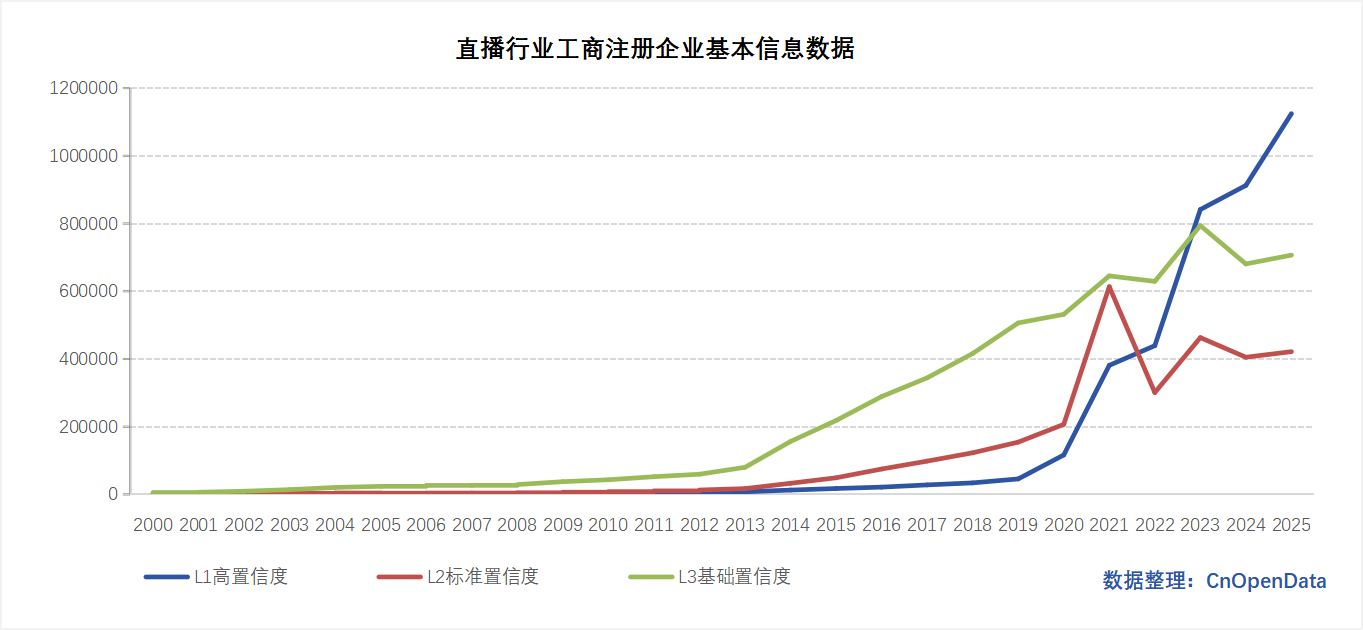
- Three-Tier Structured Design Balancing Precision and Coverage: Enterprises are classified into three confidence tiers based on the "linguistic proximity" principle, allowing users to adjust between "precision" and "coverage" flexibly. The L1 High-Confidence Tier includes enterprises explicitly featuring core keywords like "live broadcast," "streamer," or "online performance" in corporate names or business scopes, representing definitive participants in the live streaming industry. The L2 Standard-Confidence Tier covers enterprises primarily engaged in short video, online gaming, talent brokerage, performance brokerage, or film production – essential ecosystem components closely related to live streaming despite lacking explicit mentions. The L3 Foundational-Confidence Tier encompasses enterprises holding compliance licenses such as Online Culture Operation or Online Audiovisual Program Transmission, or featuring characteristic terms like "cultural media" or "network technology," indicating fundamental capacity for online cultural and entertainment operations.
- Inclusive Cross-Industry Capture Authentically Reconstructing Industry Landscape: Live streaming as a marketing tool has penetrated manufacturing, agriculture, services, and diverse sectors. By avoiding industry code pre-screening and business scope exclusion rules, this dataset effectively captures cross-industry phenomena including apparel manufacturers establishing in-house streaming teams, agricultural producers conducting direct livestream sales, and traditional retailers transitioning to live-streaming e-commerce, thereby preventing systematic omissions caused by ambiguous industry classifications or scope descriptions.
- Multi-Decadal Temporal Coverage Enabling Longitudinal Research: With underlying coverage spanning national registration records from 1950 through 2025, the dataset supports over seven decades of investigation. This longitudinal attribute provides a complete reference frame for studying the explosive growth of the live streaming industry: researchers may contrast growth trajectories between live streaming enterprises and traditional industries to observe expansion patterns of new economic formats; alternatively, track corporate registration dynamics around the pivotal year of 2016 to evaluate industry transformation trajectories under dual policy and market drivers.
Application Value:
- Digital Economy and Platform Employment Studies: Covering diverse market entities including streamer agencies and live-commerce enterprises, this data supports cutting-edge research on platform labor models, flexible employment scales, and entrepreneurial ecosystem evolution. The inclusion of keywords like "talent brokerage" within L2 enables quantitative characterization of market structures surrounding streamers as core production factors.
- Regional Economics and Industrial Cluster Analysis: Utilizing enterprise registration locations, researchers can map the spatial distribution patterns of the live streaming industry nationwide, identify industrial cluster hotspots, and analyze cross-regional supply chain divisions and collaborative networks. The geographic agglomeration characteristics of cultural/media/internet sector enterprises within L3 provide critical references for understanding talent pools, technology infrastructure, and business service ecosystems supporting the industry.
- Cross-Industry Integration and Digital Transformation Research: The dataset's inclusive design inherently supports studies on "live-streaming+" cross-sector integration phenomena. Researchers may combine industry code information to analyze market penetration rates, growth trends, and operational characteristics within traditional sectors like manufacturing, agriculture, and retail, generating quantitative evidence for industrial digital transformation.
Rooted in publicly available industrial/commerce information, this dataset establishes a multi-tiered, highly resilient corporate data architecture through rigorous, transparent, and reproducible methodology. Its three-tier structure empowers users with extensive autonomy for both precise academic causal inference and broad industry trend insights. As a fundamental data infrastructure product, it aims to provide robust data support for academic research and business decision-making across fields including digital economy, industrial economics, and regional economics.
Dataset Scale
Temporal Coverage
1950-2025 (Updatable as needed)
Field Specifications
Sample Data
Data Update Frequency
Annual updates