The CnOpenData AI Online Recruitment Position Dataset is an annual recruitment information database centered on artificial intelligence-related positions. Collected through multi-platform online recruitment channels, this dataset uses AI position-related keywords as the primary retrieval basis and employs a professional AI keyword dictionary (derived from Yao Jiaquan, Zhang Kunpeng, Guo Lipeng, Feng Xu, 2024: "How Does Artificial Intelligence Enhance Enterprise Productivity? ——The Perspective of Labor Skill Structure Adjustment," Management World, No. 2) to filter job advertisements related to AI technology. The database covers key fields such as company name, work location, position title, job description, recruitment scale, compensation, education requirements, work experience, and release date, providing a solid data foundation for studying the structure of AI talent demand, the evolution of position setup, and technology penetration trends.
Data Uniqueness
- Screening System Based on Authoritative Academic Criteria: Leveraging an AI keyword dictionary validated by authoritative academic journals, a scientific and reproducible position identification mechanism ensures high accuracy in technological relevance and industry representation.
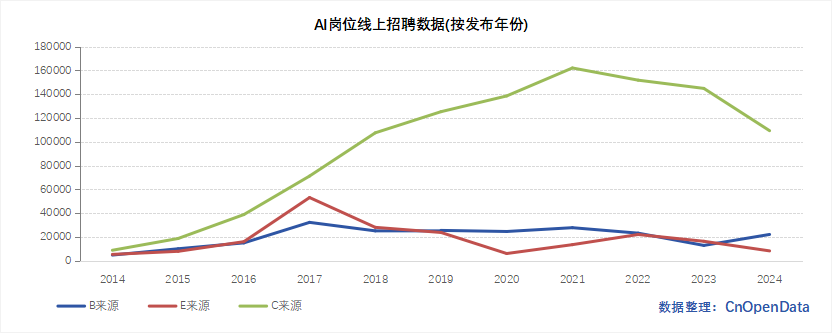
- Time-Series Data Covering the Complete AI Industry Development Cycle: Data spanning ten years comprehensively captures key development stages of China's AI industry from technological exploration to industry integration, supporting long-cycle studies on technology diffusion, talent structure evolution, and policy evaluation.
- Systematic Integration of Multi-Source Heterogeneous Data: By integrating raw data from three mainstream recruitment channels, the dataset effectively mitigates sample bias from single platforms, constructing a more representative sample system in terms of enterprise distribution, regional coverage, and position types.
Data Application Value
- Academic Research: Provides high-quality micro-datasets for innovation and labor market research, supporting empirical studies on key economics and management topics such as skill-biased technological progress, talent mobility patterns, and occupational structure transformation. Based on textual job descriptions and skill requirements, researchers can construct AI technology diffusion indices and skill complexity metrics to advance quantitative digital economics research.
- Business Decision-Making: Helps enterprises accurately grasp AI talent market competition dynamics. By analyzing salary levels, benefit structures, and recruitment scales, firms can optimize talent attraction and retention strategies. Supports investment institutions in identifying frontier technology enterprises by monitoring corporate AI talent reserves and innovation directions to assess innovation potential and industry status.
- Policy Evaluation: Provides critical evidence for assessing regional digital economy development levels. By analyzing regional distribution and mobility patterns of AI talent, supports local governments in formulating precise talent attraction and industry support policies. Assists education regulators in optimizing higher education resource allocation by aligning industry skill requirements with academic program offerings to improve talent cultivation–labor market alignment.
With its authoritative methodology, comprehensive temporal coverage, and rich dimensional information, this database has become vital infrastructure for researching AI industry development and talent market evolution. The systematic data architecture supports academic rigor while meeting practical needs for policymaking and business decisions, delivering irreplaceable value in digital economy research.
The dictionary’s contents are detailed in the table below:
Database Application Guide
CnOpenData AI Position Online Recruitment Data Application Logic: https://mp.weixin.qq.com/s/PJ1y86SEBWU7u5iNcADoKg
Time Range
May 2014 - 2024
Data Scale
Field Display
Sample Data
AI岗位线上招聘数据-B来源
AI岗位线上招聘数据-C来源
AI岗位线上招聘数据-E来源
参考文献
- 孙鲲鹏、罗婷、肖星,2021:《人才政策、研发人员招聘与企业创新》《经济研究》第8期。
数据更新频率
年度更新