This database encompasses Chinese laws, regulations, and normative documents from 1927 to the present, covering central and local legislation with over 5.27 million entries. Each record includes core metadata such as document title, legal hierarchy (效力位阶), issuing authority (制定机关), document number (发文字号), release date (公布时间), effective date (施行时间), and timeliness status (时效性). It is also linked via a unique text ID to the corresponding full text (TXT format). This massive, multidimensional dataset comprehensively documents the historical progression and latest developments in China’s legal system development, providing a solid data foundation for legal research, policy analysis, quantitative investment, and corporate compliance.
Key Features:
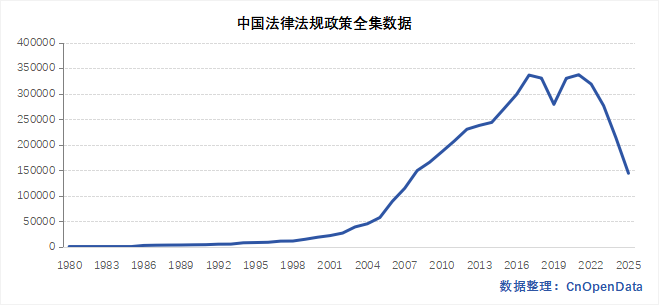
- Comprehensive Coverage with Long Historical Span: The data spans from 1927 to 2025, encompassing legislation across historical periods including pre-1949. With 5.27 million entries, regulations surged explosively post-1978 reform and opening-up, exceeding 300,000 annually in recent years, fully reflecting the evolution of China’s legal framework.
- Rich Metadata Dimensions for Flexible Filtering: Each entry includes key attributes such as legal hierarchy (效力位阶), issuing authority (制定机关), and regulation category (法规类别), enabling users to quickly locate target regulations across dimensions. For instance, users can filter all "financial" sector-specific "departmental rules" or extract all legislation by a specific authority in a given year.
- Dynamic Timeliness Annotation to Track Regulatory Evolution: Each regulation is annotated with its current status (e.g., currently effective, amended, repealed/expired, or not yet effective). This allows users to accurately identify valid norms and trace revision or repeal histories.
- Full-Text Linkage for Deep Analysis: Each regulation corresponds to its TXT full text via a "text ID," enabling direct access to complete legal provisions. The vast corpus facilitates natural language processing, text mining, and machine learning modeling.
Application Value:
- Legal Research and Policy Analysis: Scholars can conduct quantitative legislative research, analyzing shifts in legislative focus across periods, legislative activity by authorities, or amendment frequency. Timeliness data supports studies on regulatory "half-life" and repeal patterns, providing empirical foundations for legal system evaluations. Statistics reveal surges in financial regulations post-2008 global crisis and post-2015 stock market crash—this database enables rapid retrieval and policy intent analysis.
- Quantitative Investment Strategy Development: Quantitative funds can utilize regulation release dates, legal hierarchy (效力位阶), and categories as event-driven factors. Examples include positioning in stocks ahead of major policies (e.g., environmental or pharmaceutical) or predicting market risks via regulatory release frequency. Tracking annual changes in "industrial policy" regulations alongside sector indices verifies policy-market impact, offering historical backtesting for models.
- Corporate Compliance and Risk Management: Enterprises can leverage timeliness annotations to filter currently effective regulations applicable to their operations, establishing dynamic compliance lists. Monitoring new rules in specific sectors facilitates timely strategy adjustments to mitigate compliance risks. A fintech firm seeking all current "data security" regulations can filter by category (网络安全/数据安全) and timeliness (现行有效), significantly enhancing compliance efficiency.
- Artificial Intelligence and Natural Language Processing: The massive legal text corpus is ideal for training legal AI models. Researchers can develop applications for legal document generation, case element extraction, or Q&A systems. Full texts support BERT-based model training for classification, summarization, or similarity matching, enabling intelligent legal retrieval systems with precise recommendations.
CnOpenData’s China Laws, Regulations, and Policy Texts Database establishes an authoritative and reliable legal information foundation through comprehensive coverage, rich metadata, dynamic timeliness annotation, and complete full texts. Whether you are a legal scholar, quantitative finance expert, or practitioner advancing corporate compliance and legal tech innovation, this database delivers robust data support to uncover value and discern trends in your field.
Data Scale
Time Range
1949–2025
Field Display
Sample Data
Update Frequency
Annual updates