
Commercial Banks in China constitute a vital component of the nation's banking system, primarily including large state-owned commercial banks, joint-stock banks, city commercial banks, and rural commercial banks. With the deepening of market-oriented reforms in China's banking industry, the number of banking institutions continues to grow, demonstrating trends in enhanced supply capacities and refined institutional structures. As a direct reflection of human resource demands within the banking sector, recruitment data provides a robust foundation for research on financial talent policies, employment structure evolution, and regional financial layouts.
Data Uniqueness
- Long-term, High-frequency Data Accumulation: Commencing in 2014, the dataset captures recruitment information on a daily basis. This extensive coverage spans multiple economic cycles and pivotal policy moments, enabling observation of employment variations within banking industry contexts such as interest rate liberalization, fintech development, and pandemic impacts.
- Rich and Standardized Fields: Beyond conventional information such as job title, salary range, experience requirements, education background, and location, it incorporates "quantitative-research friendly" fields including language requirements, post time, and hiring quota. This breadth supports diverse research areas such as behavioral economics, human capital analysis, and labor market matching studies.
- Practical Relevance with Authentic Employment Signals: Sourced from banks' actual job postings across mainstream recruitment platforms, the data reflects genuine job responsibilities, competency requirements, compensation levels, and work arrangements, offering firsthand materials for studying "supply-demand dynamics in the financial talent market."
Data Application Value
- Analysis of Bank Human Resource Allocation: Facilitates examination of recruitment strategies employed by diverse banks across varying time periods, regions, and job categories, thereby revealing organizational expansions, structural adjustments, and talent transformation pathways.
- Research on Employment Trends and Job Structure: Empowers analysis of job popularity, shifts in educational barriers, and emergence of new roles prevailing in fields such as digital banking (数字银行), risk management (风控), and compliance (合规), supporting educational and employment policy formulation.
- Regional Financial Layout Comparisons: Spatial distribution patterns in recruitment volumes and types unveil regional business priorities and development strategies within the banking sector, contributing to the modeling and evaluation of regional financial ecosystems.
The CnOpenData Online Recruitment Data of Commercial Banks in China is a comprehensive dataset characterized by extensive coverage duration, diverse sources, and well-structured fields. It systematically documents the employment dynamics of Chinese commercial banks across distinct historical phases. This database establishes a solid empirical foundation for exploring workforce demand fluctuations and job structure evolution within the banking industry, serving as an invaluable resource for universities, research institutions, consulting firms, and financial enterprises to understand financial talent markets and uncover industry trends.
Database Application Guide
Practical Application of CnOpenData Online Recruitment Data for Commercial Banks in China: https://mp.weixin.qq.com/s/cR2QrfJk31--EUzYKrrYeA
Time Frame
2014.05–2025
Data Scale
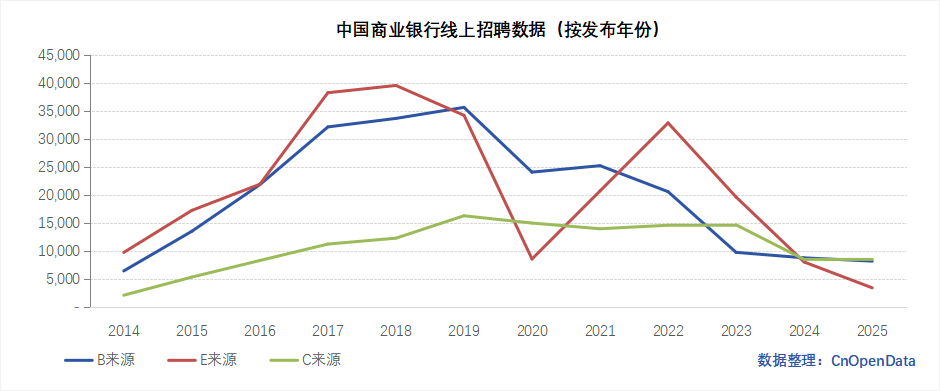
Field Display
Sample Data
Online Recruitment Data for Commercial Banks in China—Source B
Online Recruitment Data for Commercial Banks in China—Source C
Online Recruitment Data for Commercial Banks in China—Source E
Relevant Literature
- Cao Y, S. Cheng, J. W. Tucker and C. Wan, 2023, "Technological Peer Pressure and Skillspecificity of Job Postings", Contemporary Accounting Research, forthcoming.
- LUO Chuliang & LIU Pan, 2022, "Matching Efficiency of Public Employment Service Institutions and Its Regional Differences", Management World (《管理世界》), No.7.
- SUN Kunpeng, LUO Ting & XIAO Xing, 2021, "Talent Policies, R&D Personnel Recruitment and Enterprise Innovation", Economic Research Journal (《经济研究》), No.8.
- LI Bin & BAI Yan, 2020, "Signaling Mechanism of Educational Credentials: Evidence from an Applicant Resumé Experiment", Economic Research Journal (《经济研究》), No.10.
- LIU Yuyun & CHENG Yuwei, 2020, "Key Industrial Policies and Talent Demands: Microscopic Evidence from Corporate Recruitment Interviews", Management World (《管理世界》), No.6.
- GE Yuhao, DENG Jiameng & ZHANG Shuai, 2018, "Gender Discrimination in Graduate Job Markets?—Evidence from a Virtual Paired Resumé Experiment", China Economic Quarterly (《经济学(季刊)》), No.4.
Data Update Frequency
Annual Updates