
A residential community refers to a large area of residential buildings with relatively independent living environments within a specific urban region, typically accompanied by comprehensive living service facilities such as commercial outlets and schools (kindergartens). Urban residential communities, commonly abbreviated as "neighbourhoods," generally denote residential zones dominated by housing and supplemented with corresponding public facilities and non-residential buildings, including garden residences and residential clusters. Key characteristics of such communities include: diversity in housing forms, unified planning, multifunctional attributes, pluralistic property rights, and modern social dimensions.
Cities are classified into first-tier, new first-tier, second-tier, and third-fourth-fifth-tier cities based on various criteria. Common standards for categorization include: housing prices, urban development levels, living standards and per capita income, radiation-driven capacity, talent attraction, and international recognition.
CnOpenData has launched nationwide residential community data, categorizing covered cities according to specific standards:
- First-tier cities: Beijing, Shanghai, Guangzhou, Shenzhen
- New first-tier cities: Chengdu, Tianjin, Qingdao, Dongguan, Foshan, Nanjing, Suzhou, Zhengzhou, Ningbo, Hangzhou, Wuhan, Changsha, Shenyang, Chongqing, Xi'an
- Second-tier cities: Kunming, Hefei, Linyi, Jinan, Weifang, Yantai, Taiyuan, Huizhou, Zhuhai, Nanning, Nantong, Changzhou, Wuxi, Nanchang, Shijiazhuang, Taizhou, Wenzhou, Shaoxing, Jinhua, Lanzhou, Xiamen, Quanzhou, Fuzhou, Guiyang, Dalian, Harbin
- Third-fourth-fifth-tier cities: Hohhot, Jilin, Mianyang, Yinchuan, Anqing, Wuhu, Ma'anshan, Weihai, Zibo, Jiangmen, Zhanjiang, Liuzhou, Guilin, Huai'an, Yancheng, Zhenjiang, Shangrao, Jiujiang, Ganzhou, Baoding, Tangshan, Langfang, Xinxiang, Luoyang, Huzhou, Haikou, Xiangyang, Yueyang, Zhuzhou, Zhangzhou, Xianyang, Yibin, Dazhou, Beihai, Ji'an, Zhangjiakou, Kaifeng, Xuchang, Huangshi, Changde, Dandong, Fushun, Baoji, Chifeng, Liangshan, Hanzhong
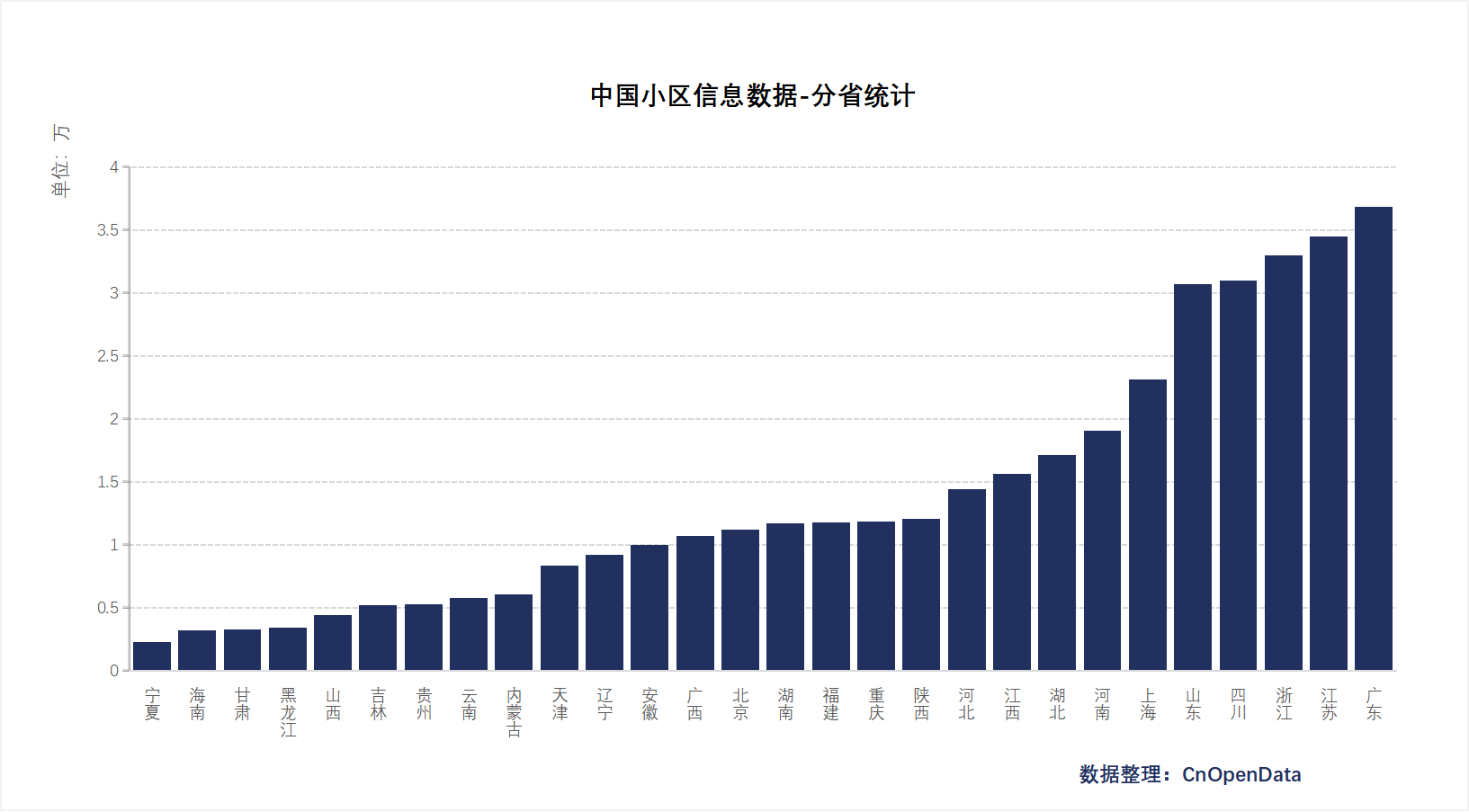
CnOpenData's Chinese Residential Community Information comprehensively covers distribution data of housing communities across 28 provincial-level administrative regions, municipalities, and 102 key cities. Furthermore, the data is categorized into four distinct tables based on city tiers, ensuring targeted analysis, clear hierarchical structure, and strong research representativeness. This dataset provides high-quality big data samples for studying China's housing vacancy rates, the effectiveness of real estate regulation policies, and future housing price trends. It also enables exploration of urban development conditions, China's urbanization process, and macroeconomic growth from a housing perspective.
Data Scale
Time Range
As of November 2024 (updatable as needed)
Field Display
Sample Data
First-tier Cities Residential Community Information Table
Related Literature
- Meng Lina, Yu Huayi & Chen Qiyue, 2024: "Pollution Information Disclosure and Public Response—Evidence from the Real Estate Market," China Economic Quarterly, No. 1.
Data Update Frequency
Annual updates