
Typhoon disasters are among the most frequent and severe natural catastrophes globally, posing a significant global challenge to human survival and development today. According to statistical data from the Typhoon Climate Change Assessment Report compiled by the Typhoon Committee under the United Nations Economic and Social Commission for Asia and the Pacific (ESCAP) and the World Meteorological Organization (WMO), tropical cyclones worldwide cause an average of approximately 20,000 deaths and over $10 billion in economic losses annually. Due to the characteristics of externality, intergenerational equity, and global scope inherent in climate issues, the impacts of typhoons and their prevention and control have remained a focal and challenging topic of widespread concern across society. Numerous academic studies have analyzed and discussed this issue, leading to the establishment of several typhoon research institutes and project initiatives.
Typhoons not only cause significant harm to nature but also exert multifaceted impacts on the economy and society. From a macroeconomic perspective, on the one hand, sudden natural disasters such as typhoons can severely damage infrastructure and buildings in affected areas and may result in substantial casualties, negatively impacting local economic development. On the other hand, however, the destruction of buildings caused by natural disasters provides an opportunity for urban architectural upgrades and new development pathways, resolving the conflict between land redevelopment and durable buildings in urban development and offering new momentum for local economic growth. At the micro level, the immense destruction caused by natural disasters places enormous fiscal pressure on local governments in the short term for disaster relief and reconstruction, potentially prompting them to strengthen tax collection from enterprises within their jurisdiction to secure fiscal resources. This, in turn, may reduce corporate tax avoidance, and these enterprises with reduced avoidance may receive more subsidies and credit resources from the government in the future.
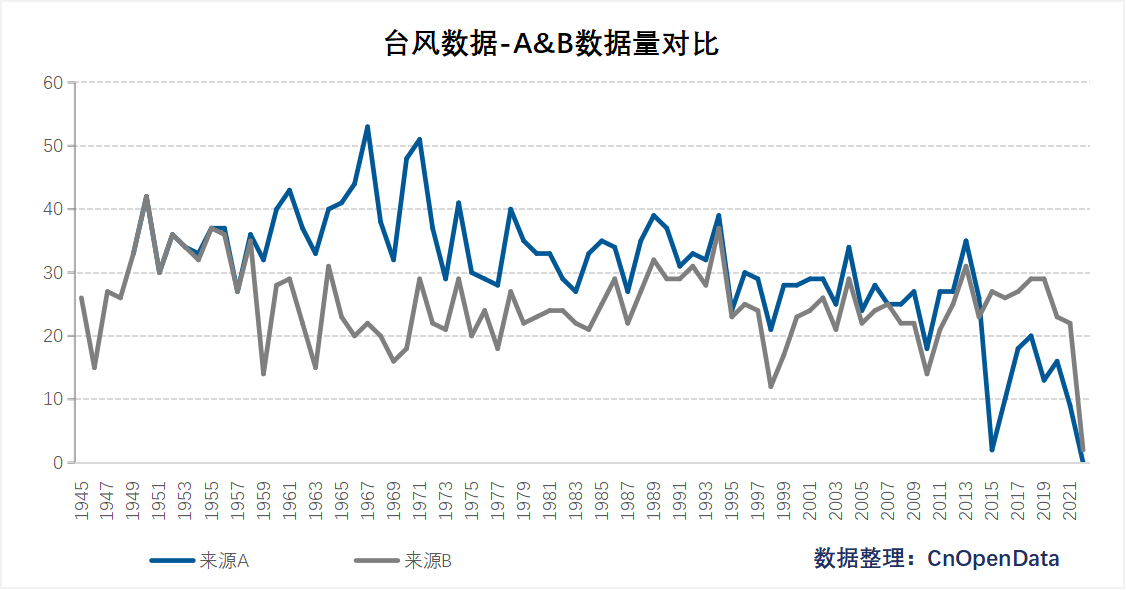
The Typhoon Database launched by the CnOpenData team includes typhoon information from two sources, each differing in fields and data volume. Scholars can freely choose based on their research needs. Among them, Source A includes three subtables: basic typhoon information, typhoon track information, and typhoon wind circle radius information; Source B includes four subtables: basic typhoon information, typhoon landfall information, typhoon track information, and typhoon forecast information. These two sources comprehensively and thoroughly cover typhoon-related information from China’s southeastern coast to the western Pacific, providing high-quality data resources for relevant research.
Time Period
- Source A: 1945–2024.9 (the wind circle radius table starts from 2015)
- Source B: 1949–2024.9 (the forecast information table starts from 2004)
- This dataset can be updated as needed
Data Scale
Field Display
台风数据-A来源
台风数据-B来源
Sample Data
Due to the numerous tables, this page only displays tables from Source A. For more information, please click on the individual tables on the left.
Basic Typhoon Information Table
Typhoon Track Information Table
Typhoon Wind Circle Radius Table
Related Literature
- Lü, Yongbin, Li Zhisheng, and Guo Yichen, 2024: "Against the Wind: Typhoon Disasters and Bank Risk Behavior," Financial Research, No. 1.
- Elliott, R.J.R., et al., 2019: "Estimating the Direct and Indirect Impact of Typhoons on Plant Performance: Evidence from Chinese Manufacturers," Journal of Environmental Economics and Management, 98: 102252.
Data Update Frequency
Annual updates